
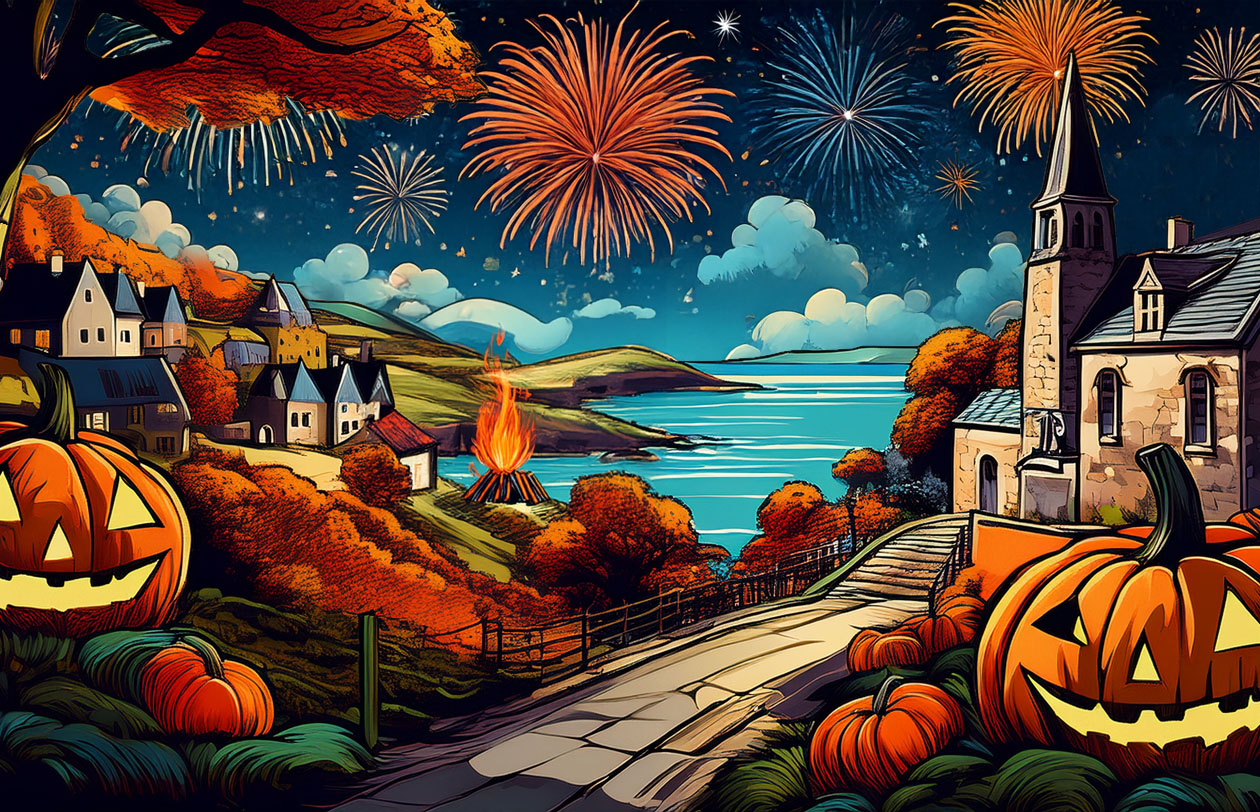
Cosy Cornish Nights and Crackling Bonfires
From glowing bonfires to storm-lashed coasts, here’s how Cornwall embraces the magic of autumn
Autumn in Cornwall? Turns out most of you are genuinely into it.
Between 10th-17th October 2025, we asked 139 Cornish residents about Autumn in Cornwall, and over three quarters (78%) “Love it” or “Like it”, and almost everyone else simply doesn’t mind it. Only 1 in 20 say they are not fans of the season.
What is the best bit about Autumn?
It is Cornwall’s natural beauty at this time of year; the colourful leaves and countryside (58%) and the stormy seas and dramatic weather (40%). Cosy evenings at home (29%) and cosy pubs and social nights out (13%) are also popular parts of the season. 7% like the fact that most of the tourists have gone by the Autumn, making it easier for residents to get out and about to enjoy quieter beaches.
Halloween: getting too commercial for the grown-ups, but fun for the children
Opinions on Halloween are mixed. two in five (40%) say they never, or rarely, mark Halloween, whilst one in five (20%) mark it every year and another one in five (21%) do so sometimes – so it’s a bit of a split between those who join in and those who don’t.
Of those who do mark it, half (51%) give out sweets, a third (36%) carve pumpkins and one in five (22%) attend local events. Dressing up for the occasion (14%) or going out trick or treating (11%) are not (yet?) big in Cornwall. A few of the panel mentioned that they enjoy decorating their house or watching spooky movies. Some respondents actively celebrate Halloween’s pagan roots, while others observe the occasion in ways that emphasise their Christian beliefs.
Most respondents value Halloween as a time for children’s trick-or-treating and dressing up, often accompanied by house decorations and local community events, fostering a sense of friendliness and continuity. A quarter (25%) think their communities pitch the celebrations at the right level, not too much, not too little, but a third (32%) see Halloween as overly commercialised. Most of the remainder either see Halloween celebrations as simply irrelevant to themselves (12%) or actively dislike the extent or manner of its celebration (12%).
Bonfire Night: community spirit and distressed pets
Many appreciate Bonfire Night for its fireworks and organised displays, often highlighting the community spirit and family-friendly atmosphere that accompanies them. But feelings are again mixed: whilst a third (34%) think their community gets this about right, 29% think it is too noisy, too dangerous, too commercial, or simply dislike it as a celebration. One in ten (10%) would like to see it celebrated more.
Of course, it is not universally marked by everyone – only half (53%) celebrate it, at least some years. Whilst one in five (18%) mark it every year, an equally number (18%) never do so.
Of those who do celebrate 5th November, most either attend a big firework display (46%) or watch fireworks from afar (54%). Domestic fireworks, low-noise fireworks and at-home bonfires are less common. Notably, for nearly a quarter (22%) their focus is on comforting pets who find the noise distressing.
The responses show a real tension about this time of year: community fun versus disturbance – and for many households with nervous pets, it’s not a small issue.
Remembrance: widely marked, widely respected
Remembrance Day stands out as the Autumn occasion that most respondents mark. Not surprising, given that 62% have a family member or friend who has served, or is currently serving in the military, or they themselves are current or former military personnel.
Over three quarters (78%) mark Remembrance Day (over half – 53% – doing so every year, whilst one in 7 (14%) say they never mark the occasion). Two thirds (68%) think their communities honour Remembrance Day about right (14% think it is not marked enough, 7% think too much is made of it).
Most value Remembrance Day for its parades, services, and community ceremonies, which bring people together and provide a solemn opportunity to reflect on the sacrifices of those who served. A smaller proportion note that their community does not mark the day or express objections to aspects of the celebration, perhaps seeing it as a glorification of war, or overemphasising national pride when they feel it should be a time of quiet personal reflection.
Of those who do mark the day, most wear a poppy (81%) and most observe the two-minute silence (81%). Many follow national events on TV or the radio (41%) or attend a local service or parade (35%).
Which occasion stands out – and which is overlooked?
When asked which occasion is most strongly marked locally, Remembrance Day is the top pick (35%). Halloween and Bonfire Night are tied (17% each). Asked which is most overlooked, most people said “None of them are really overlooked” (49%), suggesting that while some may dislike certain elements (commercialisation, noise, glorification), the big Autumn occasions are visible enough across Cornwall.
A few local touches and voices
We also asked about Autumn traditions that feel especially Cornish. Responses ranged from the expected – local parades and village events – to small practical traditions and personal rituals: people mention visiting local services, making community displays, and simple pleasures like “shop window displays” and children dressing up.
Two specific traditions did stand out, though not mentioned by many:
Crying the Neck – a traditional West Country harvest celebration that involves a farmer cutting the last sheaf of corn and proclaiming “I ‘ave ‘un! I ‘ave ‘un! I ‘ave ‘un!”. The crowd responds: “What ‘ave ‘ee? What ‘ave ‘ee? What ‘ave ‘ee? A neck! A neck! A neck!”. This is done to symbolise the end of the harvest and is often accompanied by communal feasts and celebrations. The tradition has its roots in pagan customs and has been revived in various locations, reflecting Cornwall’s agricultural heritage and community spirit.
Samhain – an ancient Celtic fire festival celebrated on the evening of 31st October and into 1st November, marking the end of the harvest season and the beginning of winter. It involves bonfires, feasting, offerings to spirits, divination and honouring of the dead, and wearing costumes to ward off mischievous spirits. As with Halloween, the boundary between the living and spirit world is believed to be thin, allowing spirits to roam freely. Both Samhain and Halloween are Celtic in origin – All Hallows’ Eve evolved from Samhain before evolving into the modern secular celebration of Halloween, with its emphasis on fun rather than spirituality.